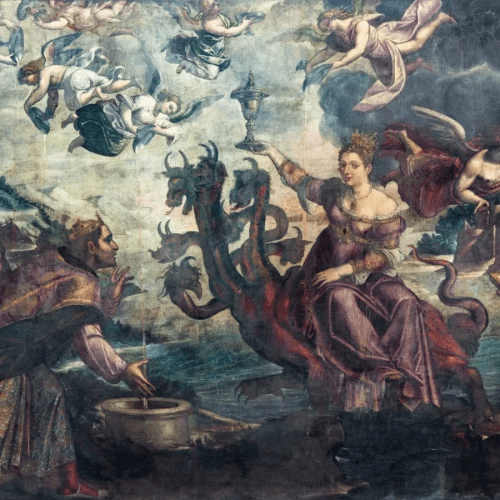
Mystery Babylon represents a woman who is seated on a beast with seven heads and ten horns in the book of Revelation. The woman, who is clothed in purple and scarlet colors, is the symbol of a city built on seven hills. She holds a golden cup in her hand, filled with abominations, and the inhabitants of the earth have become drunk with the wine of her fornication (Revelation 17:6).
Out of all the cities that could represent who Babylon is, there is only one that can clearly fit the criteria of the woman. The most accurate city that does fit her description is Rome, where the headquarters of catholicism is and the future of the revived Roman Empire.
The Tower of Babel
It makes sense that the city is Rome instead of literal Babylon because of its rich setting apart from a desolation that doesn’t hold any of her features. When Nimrod and his wife Semiramis lived in the land of Shinar, they built the tower of Babel in the literal city of Babylon, located in the region of Mesopotamia, not far from Baghdad, Iraq.
Genesis 11 tells how Nimrod and his wife started their own religions that would be handed down to civilizations to present day polytheism. Nimrod is worshiped as the sun god (or Baal), and Semiramis, the Goddess of Ishtar, is connected to Mary when they practice the rosary. Mary is not the queen of heaven, but they worship her as the mother of harlots where governments make money off of her riches. She is not a co-mediator with Christ but was merely part of his design to enter the world.
Other cities that could fit the criteria of the woman include Jerusalem, New York City/America, or Mecca, the capital of Saudi Arabia and center of the Islamic religion. In Jerusalem, where the Jews practice the Torah throughout their local synagogues, has violated itself into becoming a dwelling place of idolatry. But no chalice is used in any religion except in Catholicism as it appears identical to the cup that she holds in her hand.
Every day around the world, Mass is performed by a priest, offering a wafer and wine to its members, who believe it turns into the literal body and blood of Christ. A priest cannot be elevated to perform that kind of activity because it would be a re-sacrifice of what Christ finished at Calvary.
The Council of Nicaea
Roman Catholicism became the first organized church that was built by those who abandoned God’s teachings. When Christ said, “I will build my church from the rock of Peter,” he was not referring to the Roman Catholic Church establishment — that was through the Council of Nicaea — which was to form an unbroken line of apostolic succession. Catholic clergy built a church to try to overshadow the gospel.
New teachings were passed down from Constantine (306-337) to form the papacy into a hierarchical system of bishops, deacons, and cardinals that supported him as the first Christian Emperor of Rome. That is when he underwent the council meetings to unite the Roman Government and church into an ecumenical body. He may have been the first Roman Emperor to cease the killing of Christians, but far more people were killed for not being part of the Catholic Church. Emperor Constantine and the Pope would conspire together to issue the Edict of Toleration that was upheld only to stand together as a Holy Roman Empire. How would the papacy then have any connection to an invisible church that is built from the rock of Peter?
Although Peter was the first pope, he was not the Pope of Rome, for he did not even travel to that city. God did not build his church off of a hierarchy to hold his power; instead, he made it so that his followers could exercise the power of his word. The Catholic Church was built physically in order to preserve an earthly empire.
Ever since Catholic apocrypha became imposed, history would be replaced by reinventing the early Christians and the apostles. When we look back at the early fathers, such as Saint Polycarp and Saint Justin, along with other martyrs (mainly from the 1st to 3rd centuries), Catholic historians made it look as though they were the ones persecuted by Rome. But they were not part of a system that is made up of seven sacraments and other unbiblical teachings.
Conclusion
Many Catholics believe that he is still dying for them in their own past, present, and future lifetimes based on how many times they take part in the Mass. But a priest still stands for that Jewish custom which Christ had to replace as the slaughter of the lamb. So how could you believe that the sacrifice occurs more than once at an altar, yet the doctrine of transubstantiation continues to be taught by the Catholic Church today? Now is the time to come out of her, at last, lest you share in her sins and receive of her plagues (Revelation 18:4).
 Bible outlook
Leave a comment