Martin Luther started the Reformation based on his work that sparked a new turning point in Christianity. A deeper look into his life will explain how he impacted society with those who followed him despite the dangers ahead.
The night Luther was struck by lightning on his way home in Erfurt, he called on Saint Anne to rescue him, saying, “Help me! I will become a monk.” This near-death experience made him take part in the sacrament of confession to later become a priest, only to find that he was being driven under those same disciplines that he grew up with as a devout Catholic. In order to find acceptance with God, he would torture himself through prayers, fasting, and freezing to escape the confusion that was haunting his mind.
While the Church was using priests to perform the sacraments, they were found to actually be subject to the extortion of Roman pontiffs, to exercise absolute power over citizens. After Luther stayed with them for a while, he embarked on a road to rediscovery by leaving the monastery. His skepticism grew on his first trip to Rome when he would decide to leave the priesthood altogether.
At the Scala Sancta, where Luther began to witness the corruption of the Roman Catholic Church, were the Holy Stairs that Jesus stepped through at his trial with Pontius Pilate. Those stairs were moved from Jerusalem to Rome by St. Helena in the fourth century. Rome was replaced as the new Holy City in terms of a lot of sacred items being kept there, including artifacts and relics, tombs of saints, and the Latin Vulgate, its first translation of the Bible by St. Jerome. Before it could be translated to understand how it was different from the Church, Luther would point out many obvious cases that he saw wrong from what he studied and experienced. He noticed that faith was being administered by clergy and enabled through merits rather than by the work of Christ. His main accusation was against the selling of indulgences in which relatives of the dead donate money to buy their souls out of purgatory.
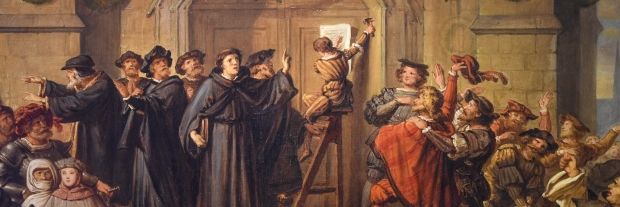
In the year 1517, Luther nailed his Ninety-five Theses on the bishop’s castle door in Wittenberg, Germany, which would be the beginning of the Reformation period. By 1520, he would complete a work in greater detail that covers his differences with the Church sacraments. The seven sacraments, part of the Magisterium system of Catholic practices, which came into existence through Roman imperialism, are explained as heresy in his book: The Babylonian Captivity of the Church.
Luther goes against the concept of bread and wine being transmitted into real flesh and blood as it is not found to be anywhere in the scriptures. However, he did affirm that God was present in a certain way during communion, in what was called “sacramental union,” but it was only to be in agreement with him, not in union with the Church. Luther confirmed in his treatise that the mass is a bloodless repetition of Christ’s sacrifice.
His writings were sent over to Pope Leo X after it was distributed throughout Germany in 1521. By then, the pope had issued the papal bull to excommunicate him, but Luther would have it burned. When Emperor Charles V threatened to have him killed at the Diet of Worms, he was protected by rich princes that came for his rescue. Afterwards, the emperor would issue a decree called “the Edict of Worms,” forbidding anyone to defend or favor his teachings.
While he was on the run, hiding in the city of Wartburg, Luther continued to translate the Bible into German, with citizens on the lookout to arrest or have him killed. Some people thought he was provoking a war with his upheaval, while others had yet to hear of him with his writings being burned by the papacy. Copies of his books still made it across Germany and to other parts of Europe through Johannes Gutenberg’s invention of the printing press.
Others who became Luther’s successors — John Calvin, Huldrych Zwingli, and his associate Heinrich Bullinger, all collaborated with the printing press — to lead the reform in Switzerland. Zwingli already knew about the corruption of the Church before Luther wrote his Ninety-five Theses. Later on, Calvin would introduce his theological doctrine of predestination, the idea that God has elected people before they were born, originally started by Augustine of Hippo. However, the Reformation continued throughout the United Kingdom.
The Reformation in England
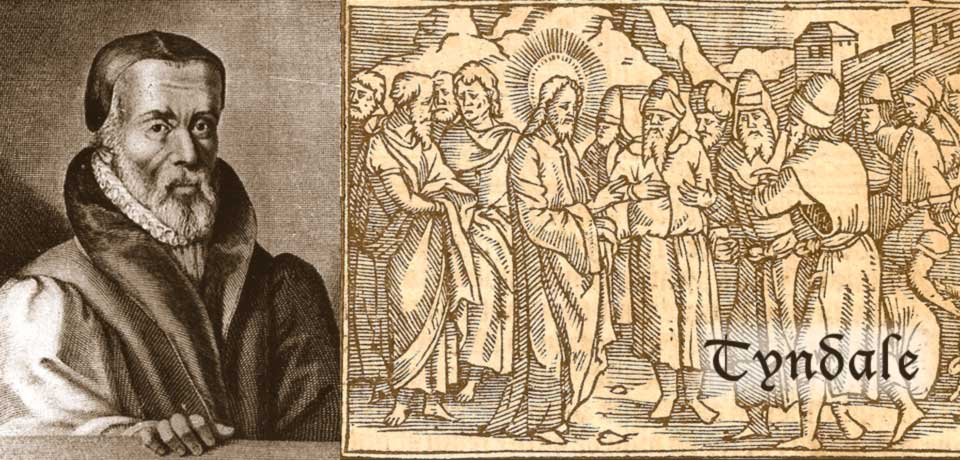
William Tyndale (1494 – 1536), another reformer who translated the Bible into English, made replicas of old versions that were stored in sections, parts which he renewed, particularly the New Testament. When John Wycliffe translated the Bible into English in the 14th century, the printing press was yet to be invented, so parts of it were only sent out handwritten at the time. In 1408, the Church had banned the English translation of the Bible anyways. Wycliffe was one of the early reformers who influenced Luther by his writings, as well as the works of John Huss.
Over a century later, Tyndale sailed to the city of Worms, having his translations printed and published, shipped overseas, and smuggled into England. He was offered a trip back to England but refused until he could legally translate the Bible into English. Bishops had burned the translations that were made by him, but over six thousand copies were distributed across Europe.
While hiding in the city of Antwerp, he continued to translate the Old Testament when agents of the King went searching for him. Unfortunately, an Englishman pretended to be his friend and had him arrested and put in prison for heresy. King Henry VIII had him strangled and burned at the stake for believing that salvation came through the gospel. Henry VIII did realize what he had done and made a copy of the English Bible available to parishioners in every church across England. The Reformation, however, would not come to an end; it continued in the United Kingdom by other theologians, such as John Knox, Thomas Cranmer, and Thomas Hitten, one of the first martyrs of the Protestant Church.
Thomas Cranmer was able to convey his doctrinal views in his books, but due to the conflict between reformers and religious conservatives, no radical changes were made to the Church during the reign of Henry VIII. Once Edward became king, he became more eager to promote his beliefs in Sola Scriptura and justification through faith alone by writing more books and exchanging letters with fellow reformers. Part of what he did was divide the Church of England and the Vatican (or the See of Rome) from remaining unanimous together. Cranmer was arrested by authorities for treason and heresy. And after being imprisoned for two years, he recanted and reconciled with the Church to avoid being executed. Cranmer’s time in prison could not be absolved, and he was about to die as a martyr of the English Reformation.
On the day of his execution, he delivered a speech to recant his writings but decided to cancel by the end of it. Instead of surrendering to the king, he ended his script, offering to burn his right hand in the fire first, not just to withstand the king and queen’s orders, but to abstain from the pope’s orders too, without sacrificing his work. As he renounced the king, he also refuted the pope as an enemy of Christ with all his false doctrine to uphold what he was establishing in England. After the deaths of Cranmer and Tyndale, the Reformation was becoming abolished in England, but it would not end without religious rights being addressed.
The Council of Trent (1545-1563) held meetings to conduct a Counter-Reformation, to reimpose Catholic doctrines, reinstate the magisterium, and mostly, to stop Protestant expansion. Partly would they allow some of what the reformers were conveying to persist by combining scripture with sacred tradition. Since they were unwilling to accept, union would not occur for most who attended the meetings except for some protestants. Where the Church became ecumenical with protestants, the reformers would maintain all they had written to point out the difference: never to conform with them on any terms, even if it meant to give up their lives.
 Bible outlook
Leave a comment