
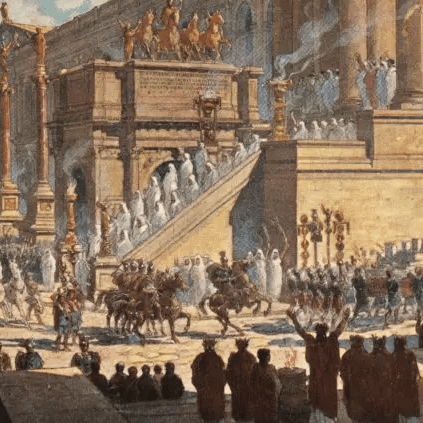
Rome was considered one of the largest empires of the ancient world, covering areas throughout the Mediterranean Sea, North Africa, and Asia Minor. Soon after the Punic Wars took place, Emperor Augustus expanded the empire across other regions such as Egypt, Spain, and certain parts of the Middle East, including the land of Judea. Once Judea had become part of the empire, it would lead to the coming of Christ to the beginning and spread of Christianity.
The reign of Augustus would eventually end with his death in 14 AD, when Tiberius became the new Emperor of Rome. When they heard about Jesus proclaiming to be the Messiah, the chief priests and elders would respond with great discouragement and plot his arrest to have him killed.
Those who plotted against him included Caiaphas, Pilate, and Judas — who was offered a bribe for 30 pieces of silver. Jesus warned his apostles that one of them would betray him for the world. But God would overcome the world by fulfilling the Old Testament law — that is, to begin a new covenant through his son — of what the gospel teaches to follow him.
Christ lived by his own teachings that we go by to overcome the old set of laws. His new teachings are how we define our belief in him apart from Jewish tradition. Even the Jewish people would follow the Ten Commandments but crucify others who had done wrongs. The two thieves would be arrested and put in prison before they faced execution with Jesus.
Christ Becomes Tempted
After learning about Christ’s teachings, the Roman Empire and majority of its citizens refused to believe that he was the Messiah. Others oversaw and gave an account of his events; for example, his encounter with the money changers, his spiritual wonders, including his ability to heal and perform miracles, and the moments leading up to his crucifixion.
The twelve men who stayed with Jesus became concerned that he would be taken captive by the Romans. They wanted to protect Jesus no matter where they were to follow him. But he was tempted by the devil at the Garden of Gethsemane, where he asked to pass on this cup, not to carry the burden, and to turn over his cross, but he obeyed God.
His point then was not to prove that he’s the savior on earth, but to allow the world to believe he is. He wasn’t going to save himself for his kingdom to reign on earth but become a sacrifice to justify people through his own blood.
Pontius Pilate
When Pilate questioned Jesus about being King of the Jews, he answered, “My servants would have fought if my kingdom were of this world”; therefore, he would not release himself, nor would Pilate except on his own terms. After they chose to free a robber named Barabbas instead, Pilate washed his hands clean to say he is innocent of this man. Pilate did not sentence Jesus crucified by his own authority; in fact, he didn’t convict him of anything during the trial. By rendering Christ innocent, he tried to vindicate himself from what they were about to do to him under Roman law.
His position could not decide Jesus’ death by any means. Even if he were to say, “live,” it would be in conjunction with Rome and denial that he’s God, who held his own power to lay down his life. Jesus put himself on trial under Roman law in order to fulfill the law of Moses. Since he did not break any law, Pilate had no say in what Jesus was to carry out. He did not understand the spiritual element of sin and what Christ had to do by giving into the demands of the world and the Roman system.
Although he may have tried to waiver off the accusations toward Jesus, he didn’t know that his sin was still pushing the Lord, leaving the final verdict up to the crowd — a decision made by the Jews, one that doesn’t involve himself. Pilate’s motives not to crucify the Son of God were unjustified by an act of self-righteousness. You can only become righteous by what Christ had to do, so in effect, he acted upon the circumstance of his crucifixion, unaware that he was also a sinner.
The Romans who crucified Jesus wanted to prevent their emperor from falling inferior and the empire from being destroyed. In fact, the Roman Empire still put forth its policies to stop Christianity after the death and resurrection of Christ. Anyone who was found to be a Christian would be put to death or imprisoned; almost all of the apostles were, that is, for teaching God’s work of salvation and his power over all the earth.
 Bible outlook
Leave a comment